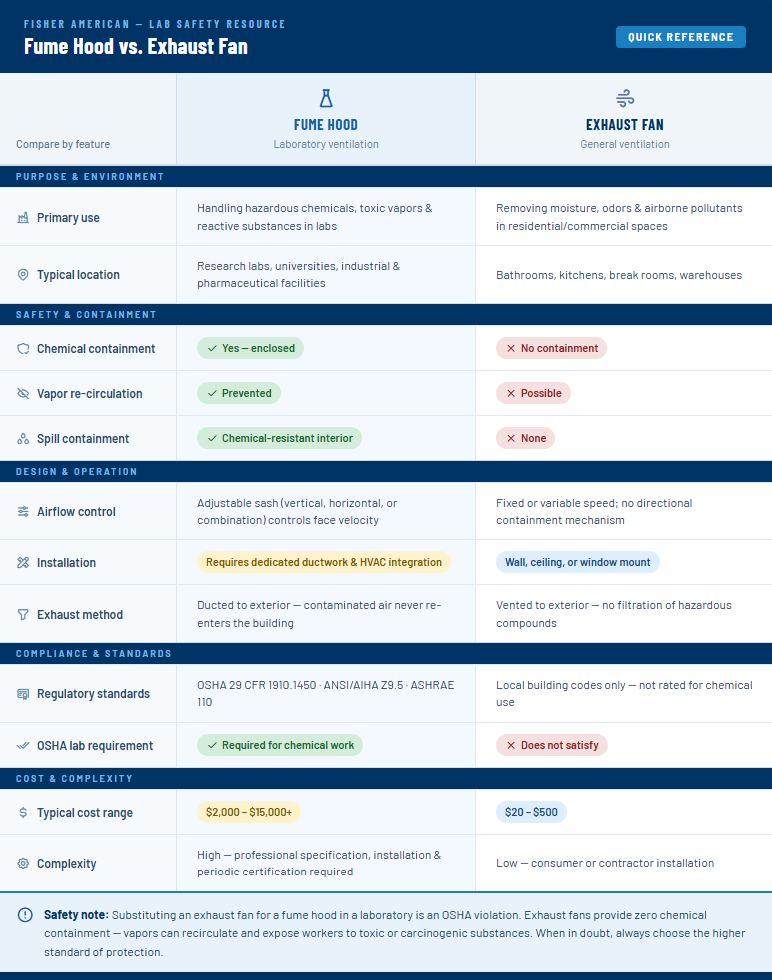


Using an exhaust fan where a fume hood is required isn’t just an equipment mismatch — it’s a safety violation that can expose workers to toxic fumes and trigger OSHA citations. If you’re evaluating ventilation options for a laboratory, here’s what you need to know before making that call.
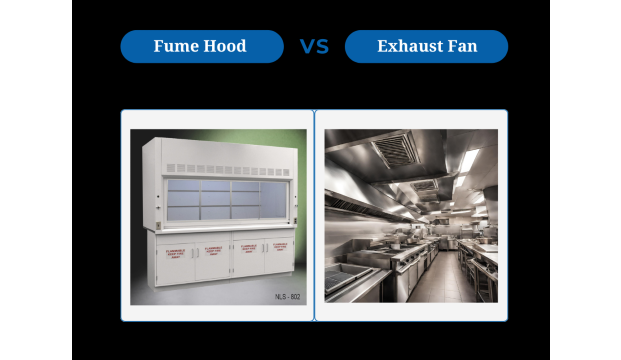
While both devices aim to remove air from a space, fume hoods are specialized for the safe handling of dangerous chemicals and include features for containment and operator safety. An exhaust fan, on the other hand, is more about general air quality and moisture control in less hazardous environments.
Fume Hood
Purpose
As the most important appliance in a laboratory, fume hoods keep employees safe by removing harmful vapors and chemicals from the work area. The air they extract is then filtered by the building’s exhaust system before exiting the facility, thus limiting exposure to hazardous or toxic fumes, vapors, or dust.
Related:
What is a Fume Hood? · How Does a Fume Hood Work?
Design
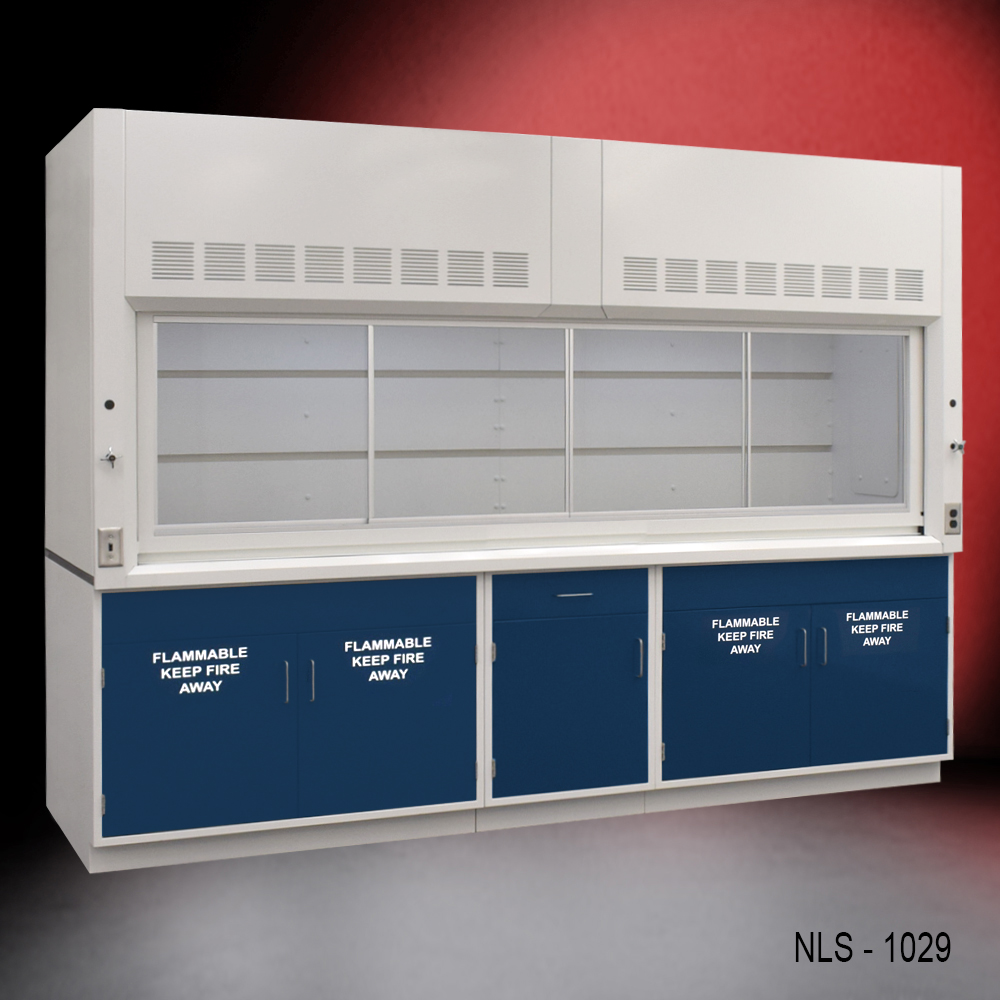
A fume hood consists of an enclosed work area with a movable front sash (window) that can be adjusted to control airflow. The interior of a fume hood is designed to contain spills and is resistant to chemical attacks.
Operation
Air is drawn in from the front of the hood (where the operator stands) and exhausted through ductwork to the outside environment, ensuring that no contaminated air circulates back into the room.
Exhaust Fan
Purpose
An exhaust fan is generally used to remove airborne pollutants, moisture, and odors from a room or building. It is commonly found in bathrooms, kitchens, and other residential or commercial spaces.
Design
An exhaust fan is simpler in design than a fume hood and can be installed in walls, windows, or ceilings. It does not have the specialized containment features that a fume hood has.
Operation
Exhaust fans work by pulling air out of the space and discharging it outside, which helps in general ventilation and controlling the air quality.
Ready to Equip Your Lab with the Right Protection?
Fume hoods and exhaust fans both ventilate spaces, but are tailored for different uses.
If you’re working with hazardous chemicals, volatile organic compounds, or regulated substances, you need a fume hood, not an exhaust fan.
If you’re ventilating a break room or bathroom, an exhaust fan is appropriate. When in doubt, err toward the higher protection standard.
Fisher American manufactures UL-listed bench and walk-in fume hoods in 3 ft to 12 ft widths, with optional storage cabinets.
Browse Fume Hoods · Talk to an Expert · (800) 419-1900