



Fume hoods protect laboratory personnel from hazardous vapors, aerosols, and particulate matter. Because they are designed to capture and exhaust harmful air, many people assume they are also appropriate places to store chemicals. That assumption is incorrect. Storing chemicals inside a fume hood creates safety hazards, violates widely accepted laboratory standards, and reduces the hood’s effectiveness.
We’ll explain why chemicals should never be stored in a fume hood, what can go wrong when they are, and where chemicals should be stored instead. It also aligns closely with NFPA-45 guidance and common EHS policies, so laboratory managers can make decisions that protect people and property.
Quick Answer: No, You Should Not Store Chemicals in a Fume Hood
A fume hood is meant for active work involving hazardous fumes, not long-term or short-term storage. Leaving chemicals inside a hood increases fire risk, raises the likelihood of accidental mixing, and restricts airflow, causing the hood to perform below required safety thresholds.
Laboratory codes and best-practice safety programs consistently prohibit using a fume hood as a storage unit.
Understanding How a Fume Hood Works
A chemical fume hood pulls contaminated air away from the user and expels it through a dedicated ventilation system. This process:
- Contains hazardous fumes at the source
- Moves contaminants away from the breathing zone
- Reduces concentrations of volatile compounds
- Protects nearby personnel by maintaining negative pressure within the hood
For the airflow to remain reliable, the interior must stay clear. Clutter, stored containers, and boxes change the air pattern and make a hood far less protective.
Related Article: Can a Bio-safety Cabinet be Used as a Fume Hood?
Why Storing Chemicals in a Fume Hood Is Unsafe
Airflow Obstruction Reduces Containment
Every item left inside the hood disrupts the sash-to-exhaust airflow pattern. Even small bottles can create turbulence that lets hazardous vapors escape into the room.
Fire and Explosion Hazards
Storing flammable liquids or reactive materials in an active hood increases the chance that vapors accumulate and ignite. If ignition occurs inside the hood, the event can be more severe because of the continuous air movement feeding the flame.
NFPA-45 makes this clear by classifying fume hoods as working devices, not storage spaces.
Accidental Chemical Interactions
Chemical bottles stored next to one another may:
- Leak or off-gas into the workspace
- React with incompatible neighbors
- Produce toxic fumes
- Corrode shelving or disposables left inside the hood
Even experienced lab staff can forget which materials were placed in the hood, leading to avoidable incidents.
Operational Issues for Laboratory Personnel
A hood crowded with stored items:
- Prevents safe movement during experiments
- Encourages unsafe workarounds (e.g., working in front of stored items)
- Can trigger airflow alarms
- Exposes staff to unnecessary hazards when the sash is raised
Over time, staff may not even notice the clutter, making it an ongoing risk.
Where Chemicals Should Be Stored Instead
Ventilated Chemical Storage Cabinets
For materials that require ventilation, dedicated chemical storage cabinets are designed to manage fumes without affecting laboratory airflow or hood performance.
Fisher American offers cabinets that support:
- Corrosive chemical storage
- Solid and liquid chemical segregation
- Interior airflow features
- Construction designed for long-term performance
Flammable Storage Cabinets
Flammable liquids must be kept in purpose-built cabinets that meet OSHA and NFPA specifications. These cabinets offer fire-resistant construction, proper labeling, and spill containment.
Under-Hood Base Cabinets (When Labeled for Chemical Storage)
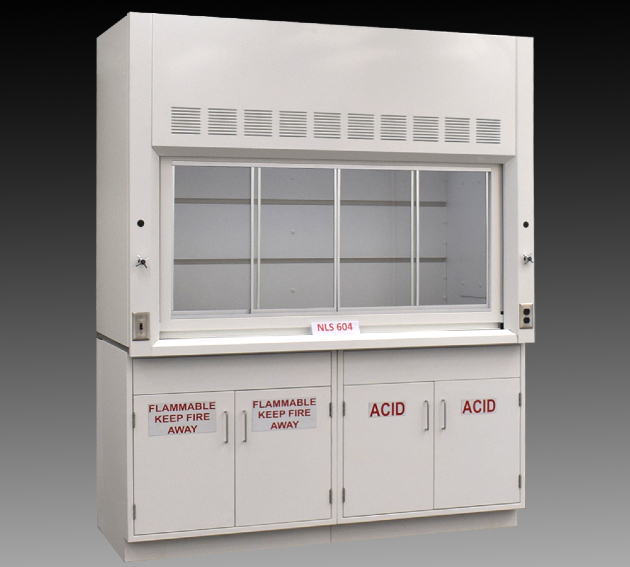
Some fume hoods include base cabinets designed specifically for storing certain classes of chemicals. These are not interchangeable with general cabinetry. Only cabinets marked and rated for chemical storage should be used in this way.
General Laboratory Shelving for Low-Hazard Reagents
Low-hazard, non-volatile materials may be stored on open shelving that follows lab grouping protocols for acids, bases, oxidizers, solvents, and other common categories.
How Fisher American Supports Safer Chemical Storage
If your laboratory needs proper chemical storage solutions, Fisher American offers:
- Ventilated chemical storage cabinets
- Flammable liquid storage cabinets
- Corrosive-resistant cabinets
- Fume hoods with compatible base cabinets
Each product is built to support safety standards and to help laboratory managers reduce hazards caused by improper storage practices.
Summary: Never Store Chemicals in a Fume Hood
A fume hood is a safety device for controlling hazardous fumes—not a shelf, not a cabinet, and not a storage room. Storing chemicals inside a hood:
- Violates safety guidelines
- Interferes with airflow
- Raises the risk of fire or accidental chemical reactions
The best way to protect your team is to keep hoods free of stored materials and use proper storage cabinets suited to each chemical class.
If you need guidance on choosing the right chemical storage cabinet for your facility, Fisher American can help.