

TL;DR
Key Takeaways
- Off-the-shelf fume hoods fit standard labs. Custom hoods are warranted when your chemicals, space, equipment, or regulatory requirements fall outside standard configurations
- Minimum face velocity of 80-100 fpm is required under ANSI/AIHA Z9.5-2012. Some applications require higher velocities or specialized airflow patterns.
- Material selection (epoxy resin, stainless steel, polypropylene) must match your chemical inventory, not just your budget.
- Small labs with limited space benefit most from compact, ducted, or ductless recirculating designs sized to the room’s HVAC capacity.
- Customization adds cost and lead time. Evaluate whether your needs truly exceed SEFA 1.2 or ASHRAE 110-tested standard units before specifying custom.
Do you need a Custom Fume Hood?
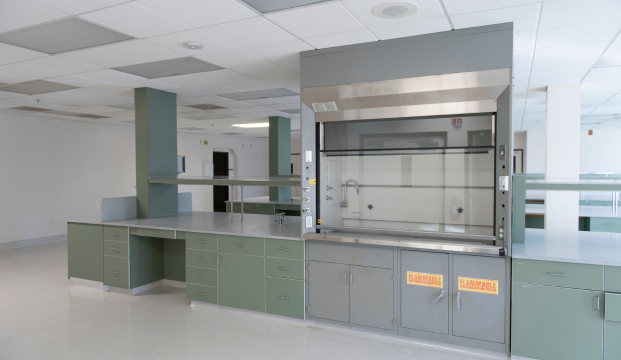
Standard units tested to ASHRAE 110 and sized correctly for your HVAC system will serve the majority of applications. Custom fume hoods are justified when your work involves atypical chemicals, non-standard equipment footprints, highly restricted floor space, or regulatory mandates that standard units cannot satisfy.
If you are evaluating a custom fume hood for the first time, start by auditing three variables:
(1) the specific chemicals and concentrations you handle,
(2) your available floor and ceiling space, and
(3) your local HVAC capacity and exhaust requirements.
These three inputs will determine whether customization is a necessity or an avoidable expense.
What Standards Govern Fume Hood Performance?
Two standards define acceptable fume hood performance in the U.S.: ANSI/AIHA Z9.5-2012 (laboratory ventilation) and ASHRAE 110-2016 (fume hood performance testing). Compliance with both is the minimum baseline for any hood — standard or custom — used in a regulated or commercial lab environment.
Understanding these standards matters practically because they set the performance floor for any fume hood you purchase or specify:
- ANSI/AIHA Z9.5-2012: Requires a minimum average face velocity of 80–100 feet per minute (fpm) at the sash opening, with no individual reading below 60 fpm. It also governs room air balance and exhaust system design. Source: American National Standards Institute (ansi.org).
- ASHRAE 110-2016: Provides the standard test method for measuring fume hood containment using a tracer gas (sulfur hexafluoride). A hood rated AM 0.05 or better means it contains hazardous vapors at the acceptable exposure threshold. Source: ASHRAE (ashrae.org).
Which Fume Hood Materials Are Right for Your Chemicals?
Interior liner material is the most consequential specification decision for small business labs. The wrong material will degrade under chemical exposure, create contamination risk, and void manufacturer warranties. Match liner material to your chemical inventory before specifying anything else.
The four most common interior materials each have distinct chemical compatibility profiles:
| Material | Best For | Avoid With | Relative Cost |
|---|---|---|---|
| Epoxy Resin | General chemistry, acids, bases, solvents | Strong oxidizers, hydrofluoric acid | Moderate |
| Stainless Steel (304/316) | Corrosive acids, high-temp applications | Chlorinated solvents (pitting risk) | Higher |
| Polypropylene (PP) | Hydrofluoric acid, strong oxidizers, chlorine compounds | High-temp applications (>120°F) | Moderate |
| Fiberglass-Reinforced Plastic | Perchloric acid, highly oxidizing environments | Solvents, general organic chemistry | Higher |
Note: This table reflects general guidance. Always verify chemical compatibility against your specific reagents using the manufacturer’s compatibility chart or a chemical resistance database such as the one maintained by Cole-Parmer (coleparmer.com/chemical-resistance).
How Do You Specify a Custom Fume Hood for a Small or Constrained Space?
Space-constrained small business labs face two common problems: insufficient floor area for a full-width hood (typically 48–60 inches wide) and inadequate ceiling clearance for standard duct connections. Both are solvable with the right configuration, but require accurate measurements and HVAC capacity data before any quote is issued.
Compact and Narrow Hoods
Standard fume hoods range from 36 to 96 inches wide. For labs under 400 square feet, a 36-inch or 48-inch unit is typically the practical maximum. Confirm that the reduced interior depth (usually 24–28 inches) accommodates your largest apparatus before ordering. Smaller interior volume reduces airflow efficiency and may require higher face velocity to achieve equivalent containment.
Low-Ceiling Installations
Standard hood heights assume 8–9 foot ceilings with additional clearance for ductwork. Labs with 8-foot or lower ceilings may require a reduced-height cabinet with a low-profile exhaust connection. Provide the exact ceiling height and the location of any overhead obstructions when requesting a custom quote.
When Does Customization Become Necessary? Four Triggers
Custom fume hoods are necessary in four specific situations: non-standard equipment that won’t fit a standard interior, chemical inventories incompatible with standard liner materials, regulatory requirements exceeding standard hood performance ratings, and space envelopes that no standard unit can fit. Outside these four conditions, a properly sized and tested standard hood is the more cost-effective choice.
- Non-Standard Equipment Footprint: Large instruments (rotary evaporators, multi-port manifolds, tall apparatus) that exceed standard interior height (typically 32–36 inches clear) or depth require a custom-dimensioned cabinet. Provide exact equipment dimensions, including clearance needed for operation, to your vendor.
- Incompatible Chemical Inventory: If your primary reagents include hydrofluoric acid, perchloric acid, strong oxidizers, or chlorinated solvents, standard epoxy or painted steel liners are inadequate. A custom polypropylene or stainless-steel interior is required. No standard off-the-shelf hood addresses all four chemical classes simultaneously.
- Regulatory or Accreditation Requirements: Some regulated industries (pharmaceutical GMP, ISO 17025-accredited labs, certain EPA method labs) specify hood performance, documentation, or traceability requirements that off-the-shelf hoods cannot meet without additional qualification testing. Custom hoods can be ordered with factory ASHRAE 110 test reports, material certifications, and dimensional as-built drawings.
- Physical Space Constraints: If your lab cannot physically accommodate the smallest available standard hood, custom fabrication is the only option. This is more common in renovated or repurposed facilities where lab space was not originally designed for chemical work.
Work with Fisher American on Your Custom Fume Hood
Fisher American has designed and supplied fume hoods for small business labs, academic institutions, and commercial research facilities across the country. Our team provides no-cost specification consultations and can walk through any of the inputs above with you before a quote is issued.
To start a conversation: