


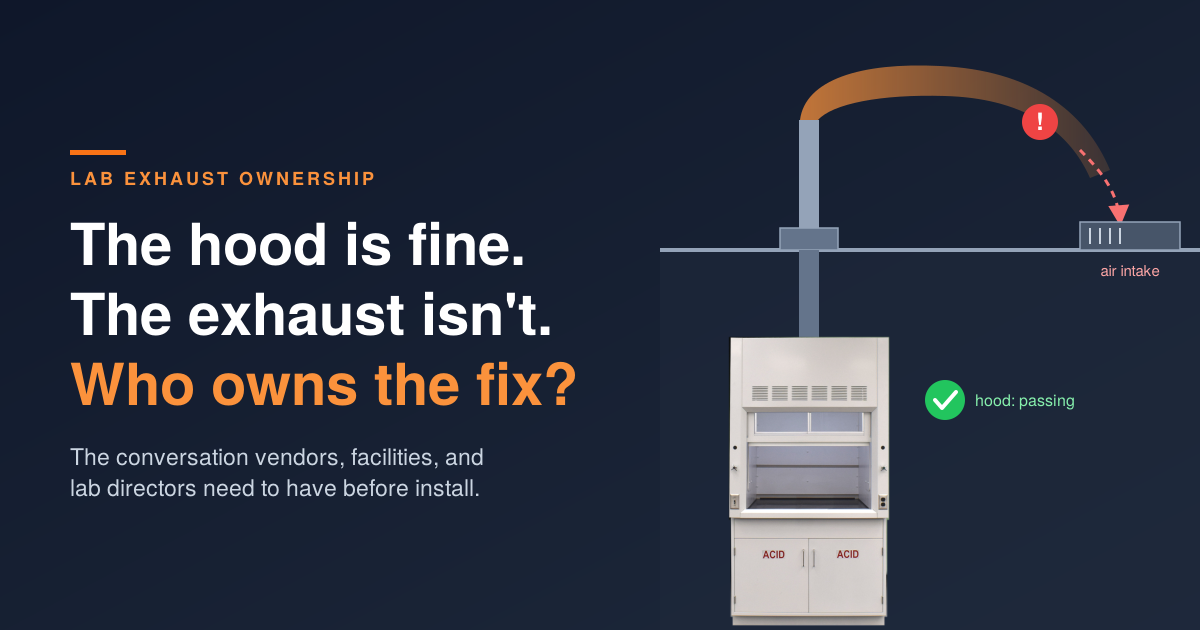
When the hood tests fine and the exhaust is the problem, facilities owns the fix. The duct, fan, stack, and air intakes are building systems. The vendor owns the hood and its test data. The lab director owns how the hood gets used and reporting when something’s off. The fight starts when nobody agreed to that before install.
TL;DR
- A hood can pass its factory test and still leave the lab smelling. When it does, look downstream: the duct, the fan, the stack, and the nearest air intake.
- A fume hood warranty covers the hood. It doesn’t cover stack height, exit velocity, or where the plume lands.
- Facilities and the design engineer own the exhaust path. The lab director or lab manager owns use and reporting under the chemical hygiene plan. The vendor owns the box and its performance data.
- The 10 ft stack height and 3,000 fpm exit velocity in ANSI Z9.5 are minimums. They don’t prove a design is safe. A site-specific dispersion analysis does that.
- Settle ownership in writing before install, and tie it to the as-installed ASHRAE 110 test.
- We haven’t counted how often exhaust problems get blamed on hoods, and we haven’t found anyone who publishes that number.
How do you know the building exhaust is the problem and not the fume hood?
Suspect the building when the hood holds face velocity and passed its factory test, but people still smell chemicals. Same goes for an as-installed tracer gas test that fails in odd ways, or complaints that line up with wind direction or time of day. Those patterns point at the stack and the intakes.
Signs worth writing down when they show up:
- Odors in the lab, or in rooms on the same air handler, while the hood monitor reads normal.
- Complaints that cluster on certain days, certain wind conditions, or after the HVAC system sets back for the night.
- Smells near rooftop air intakes, operable windows, or doors close to the stacks.
- Tracer gas readings during commissioning that don’t make sense for a leak at the sash.
That last one has a known explanation. In an ASHRAE announcement for its lab exhaust stack course, the instructor said a poorly designed exhaust system can put more fume hood exhaust at a rooftop intake than in front of the hood itself, by an order of magnitude. He also said a failed ASHRAE 110 containment test can come from tracer gas re-entering through the ventilation system rather than leaking out the front.
So a failed test can be the building talking. Read it that way before you call the vendor.
Why doesn’t a fume hood warranty cover a bad exhaust stack?
A warranty covers defects in the hood. The vendor’s performance claims rest on an as-manufactured test run in controlled conditions. The vendor didn’t choose your stack height, your fan, or where the air intake sits. Their warranty can’t cover what those choices do once the air leaves the hood.
ASHRAE 110 splits testing three ways for exactly this reason. Per AIHA, as-manufactured (AM) tests evaluate the hood’s design before purchase, and as-installed (AI) tests evaluate it in the real lab during commissioning. Same hood, different conditions, different owners.
Who owns what: the vendor, facilities, or the lab director?
Each party owns the piece they control. The vendor controls the hood. Facilities controls everything from the duct collar to the top of the plume. The lab director controls what goes in the hood and whether problems get reported. The safety officer sets the acceptance criteria and referees when the pieces don’t line up.
The vendor owns the hood and its test data
- Hood design and construction.
- The as-manufactured test report.
- The exhaust flow and static pressure the hood needs at your planned sash heights.
- A clear statement of what the warranty excludes.
Facilities owns the exhaust path from duct to plume
- Ductwork, fans, stacks, and VAV controls.
- Air intake locations and anything on the roof that changes airflow.
- The design engineer who sized all of it.
- Later changes: a new rooftop unit, a screen wall, a taller building going up next door.
The lab director or lab manager owns use and reporting
OSHA’s Laboratory Standard requires the chemical hygiene plan to include measures that keep fume hoods functioning properly (29 CFR 1910.1450(e)(3)(iii)). That duty sits with the employer, and many institutions push it down to the lab.
The lab director also owns the chemistry. What goes in the hood decides how much dilution is enough at the intake.
The safety officer sets the bar
EHS defines what "passing" means, picks or approves the tester, and keeps the records. When vendor and facilities disagree, EHS holds the data.
| Question | Vendor | Facilities / design engineer | Lab director / lab manager | Safety officer |
|---|---|---|---|---|
| Does the hood contain as built? | Owns | Reviews AM report | ||
| What exhaust does the hood need? | Owns | Confirms it can deliver | ||
| Stack height and exit velocity | Owns | Reviews | ||
| Intake locations and re-entrainment | Owns | Reviews | ||
| What chemicals go in the hood | Owns | Reviews | ||
| As-installed test criteria | Supplies data | Owns | ||
| Reporting odors and failures | Responds | Owns | Investigates |
What do ANSI Z9.5 and NFPA 45 actually require for lab exhaust stacks?
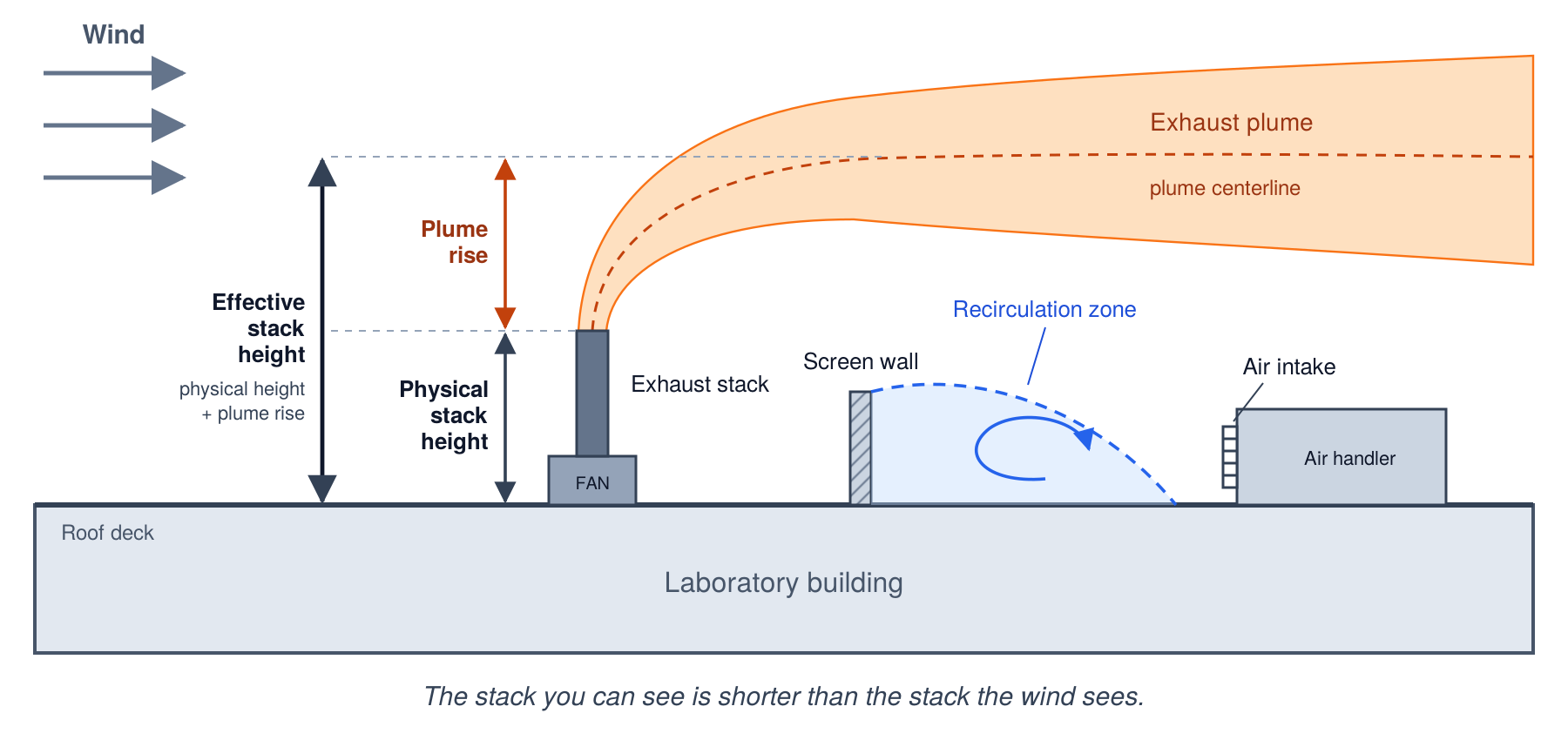
ANSI Z9.5 sets a minimum stack height of 10 ft above the roof and a minimum discharge velocity of 3,000 fpm. NFPA 45 points to the same 10 ft. Both are floors. Neither one tells you the plume clears your intakes. Your building, your neighbors, and your chemistry decide that.
What the minimums do and don’t cover:
- The 10 ft height protects people on the roof. The I2SL best practices guide says the 10 ft minimum exists to protect rooftop workers, and that dispersion modeling is the way to judge whether a design avoids re-entrainment.
- 3,000 fpm isn’t a safety guarantee. The same guide points to Z9.5’s own appendix, which warns that 3,000 fpm shouldn’t be assumed safe. No single exit velocity can be.
- Real projects can need far more. A 2020 ASHRAE Journal case study found that, for one building, 10 ft stacks would have needed an exit velocity of about 16,552 fpm to disperse acceptably. Taller stacks brought that requirement down. That’s one project. It shows why we won’t hand you a "correct" number.
- The usual intake separation table doesn’t apply. ASHRAE’s interpretation of Standard 62.1 notes its minimum separation distances don’t cover fume hood exhaust outlets. Hood exhaust gets handled under NFPA 45 and Z9.5 instead.
- Caps and screens matter. The I2SL guide notes that solid screens around rooftop equipment can lower the effective stack height.
What should each party answer before the fume hood is installed?
Get three answers in writing before installation: what exhaust the hood needs, whether the building can deliver it in every operating mode, and what the lab director plans to run. Then name who fixes what if the as-installed test fails. The meeting takes an hour. A stack retrofit takes a roofing crew.
Questions for the hood vendor
- Can we see the as-manufactured test report and the conditions it was run under?
- What exhaust flow and static pressure does the hood need at each sash height we plan to use?
- What does the hood assume about the exhaust system and room air?
- What does the warranty exclude? Put it in writing.
Questions for facilities and the design engineer
- Does this hood get a dedicated fan, or does it tie into a manifold? Which stack does it leave through?
- How tall is that stack above the roof, and what’s the exit velocity at minimum flow? Ask about night setback and VAV turndown, not only design flow. A Consulting-Specifying Engineer piece on lab exhaust energy strategies stresses that VAV systems must not compromise air quality at nearby intakes.
- How far is the stack from every air intake, operable window, and door, and is there a clear line of sight between them?
- Has anyone run a dispersion analysis, wind tunnel, or numerical? When? What’s changed on the roof or next door since?
- Are there rain caps or screen walls near the stack?
Questions for the lab director
- What chemicals, in what quantities, and how toxic? Will that change in the next two years?
- Does any process need special exhaust? Perchloric acid work, for example, generally can’t share a manifold. Johns Hopkins’ design standard bars perchloric exhaust from joining other systems.
- Who in the lab reports odors, and to whom?
Write the answers down
Put the answers in a one-page responsibility matrix. Have the vendor, facilities, the lab director, and EHS sign it. Attach it to the purchase order or the project closeout. Include the as-installed acceptance criteria and who pays for a retest.
Who should run the as-installed ASHRAE 110 test, and what does a failure tell you?
Use a tester everyone agreed on before install, and run the as-installed test before chemicals go in the hood. If containment fails while face velocity looks right, check the room and the exhaust before blaming the hood. Decide in advance who pays for the retest.
- Independence. The NIH fume hood testing protocol calls for testing conducted independently of both the hood manufacturer and the control system manufacturer. That keeps the vendor out of grading its own work.
- Timing. Run the test after the hood is installed but before anything is placed inside. That’s your cleanest look at how the room and building affect the hood.
- Reading a failure. Leakage at the sash with cross drafts points at room air: supply diffusers, door traffic, hood placement. Those are facilities issues too. Tracer gas showing up away from the hood, or rising background levels, points to re-entrainment. Either way, the hood is the last suspect when its AM data is good.
What do you do when nobody has had the conversation and the lab already smells?
Treat it as an exposure problem first and an ownership problem second. Stop or move the work, log when and where people smell it, and get EHS and facilities on the roof together. Then pull the as-installed records. The paperwork you skipped before install gets written now.
- Protect people. Pause the work or move it to a hood on a different exhaust path. EHS decides whether air sampling is needed.
- Log every complaint. Time, location, what was running, weather, and what the HVAC system was doing.
- Check the hood. Confirm face velocity and monitor readings. If they’re normal, say so in writing so the conversation moves on.
- Walk the roof. Facilities and EHS together. Look at stack height, caps, screens, new equipment, and intake locations.
- Pull the records. AM report, AI results, design drawings, and any dispersion study.
- Assign the fix. Use the matrix above, even late.
Who should call the pre-install meeting?
The lab director should. They need the hood running, and they’re the one left with an unusable workstation if the stack turns out wrong. Get the vendor, facilities, and EHS in one room before anything ships. Walk the responsibility matrix, agree on what "pass" means, and decide who pays when a test fails.
The hood is the easy part. It shows up with a test report and a warranty. The exhaust path shows up with neither, and it’s what decides whether the lab smells on a windy Tuesday. Settle who owns it while everyone’s still on friendly terms.