


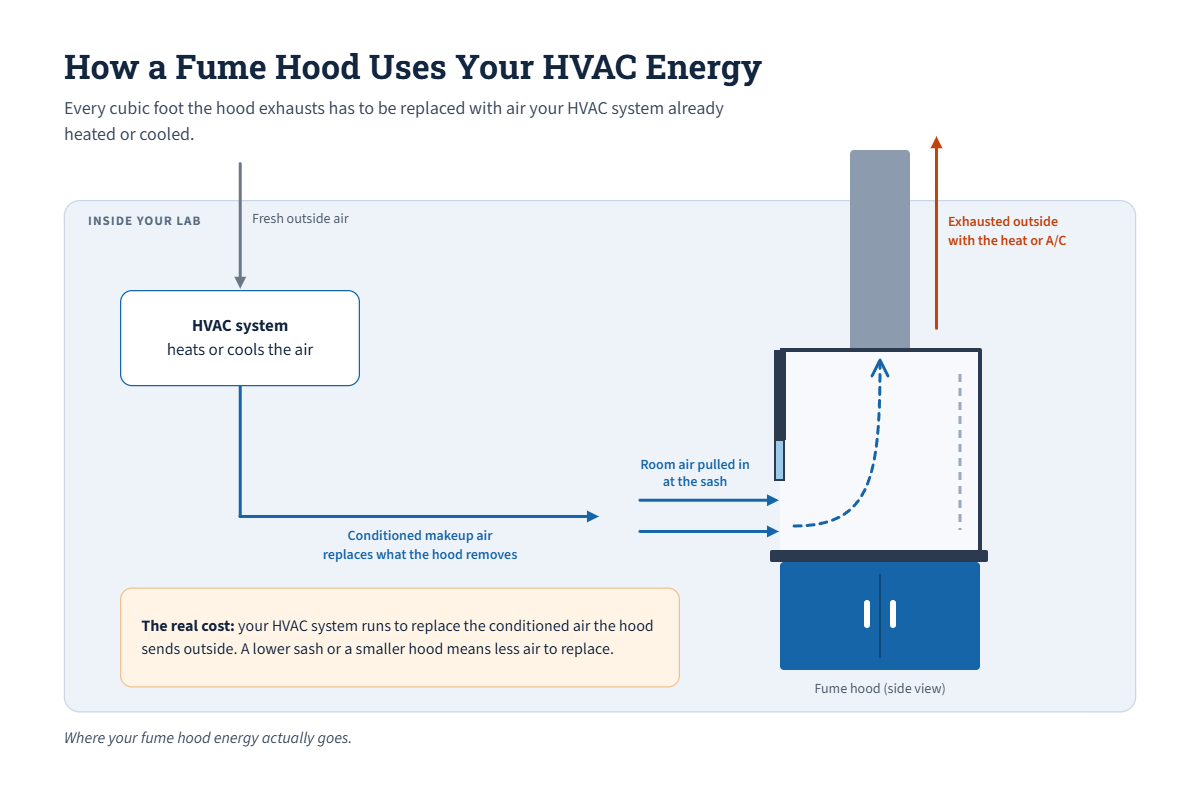
Energy-efficient fume hoods save money mostly by moving less air. Every cubic foot a hood exhausts is air you already paid to heat or cool. For a small business, the biggest savings usually come from picking the right size hood, keeping the sash down, and matching the airflow setup to how your lab actually works.
TL;DR
- A single fume hood can use about as much energy as 3.5 homes.
- Most of that cost is conditioned air going out the exhaust, not electricity for the light or fan.
- Airflow goes up with the size of the sash opening. A smaller hood or a lower sash means less air and lower bills.
- Variable air volume (VAV) systems save energy only if people actually close the sash. They cost more upfront, and payback ranges widely.
- Ductless (filtered) hoods don’t exhaust conditioned air at all, but they only work for specific, known chemicals.
- Never cut airflow below what your hood needs to contain fumes.
Cutting fume hood energy is also one of the easiest ways to make progress on your lab’s sustainability goals.
How Much Energy Does a Fume Hood Use?
A fume hood running around the clock can use about as much energy as 3.5 homes a year, according to My Green Lab. Lab Manager puts the yearly heating and cooling cost of a standard constant air volume hood at $3,000 to $8,000 in a northern climate, depending on your utility rates and weather. Newer technology can cut per-hood energy use by 50 to 75 percent, according to Lawrence Berkeley National Laboratory.
For your own estimate, plug your hood size, hours and utility rates into LBNL’s free Fume Hood Energy Calculator.
Why Does a Fume Hood Cost So Much to Run?
A fume hood is basically a machine that pulls room air out of your building. That air was heated or cooled first, so your HVAC system has to replace and condition new air to make up for it. The fan and light are small potatoes. The real cost is all that conditioned air going out the stack.
The amount of air depends on two things:
- Face velocity: how fast air moves into the hood opening, measured in feet per minute (fpm).
- Open area: how wide the hood is and how high the sash is raised.
Multiply them, and you get airflow in cubic feet per minute (CFM). As a simple illustration: a sash opening 5 feet wide and 2 feet high at 100 fpm moves about 1,000 CFM. Lower the sash to 1 foot and, on a hood that adjusts its airflow, it drops to about 500 CFM.
That’s why hood size matters. If a 4-foot hood handles your work, a 6-foot hood just means paying to exhaust air you don’t need to move.
What’s the Difference Between CAV and VAV Fume Hoods?
A constant air volume (CAV) hood exhausts the same amount of air no matter where the sash sits. A variable air volume (VAV) setup lowers exhaust as the sash closes, while holding face velocity steady. VAV saves energy, but only when the sash is actually down. Leave it wide open, and you get no savings.
| CAV | VAV | |
|---|---|---|
| How it works | Exhaust stays the same whatever the sash height | Exhaust drops as the sash closes |
| Upfront cost | Lower, simpler system | Higher, needs controls, valves and sensors |
| Energy use | Always running at full volume | Lower when the sash is closed |
| Depends on user habits? | Closing the sash doesn’t save energy | Savings depend on closing the sash |
| Best fit | Low hood counts, tight budgets, simple installs | Labs with multiple hoods and good sash habits |
Two things to know before you buy:
- Closing the sash on a CAV hood won’t lower your bill. Lab Manager points out the exhaust volume is fixed. It’s still safer, though, so close it anyway.
- A VAV hood left open is just an expensive CAV hood. Lab Manager makes this point too. VAV only pays off if you pair it with good sash habits.
Is VAV Worth the Cost for a Small Business?
Sometimes. VAV pays back faster in labs with several hoods, long operating hours and expensive heating or cooling. For a small lab with one or two hoods, the payback can be slow or may not happen at all. Get a quote and a payback estimate from your HVAC contractor before you commit.
What the data shows:
- Payback of 4 to 10 years is typical for VAV systems, according to the National Renewable Energy Laboratory. NREL also notes CAV systems are simple and cheaper upfront.
- Retrofits can be a bad deal. The University of Illinois found that converting some existing CAV hoods to VAV wasn’t feasible. Estimated paybacks in one report ran 36 and 91 years because of the building work involved.
- Total room exhaust is what matters. An NC State study found VAV hoods cut hood exhaust to about a quarter of full flow when closed. But the drop in total lab exhaust was smaller, because rooms still need a minimum amount of ventilation. In a small room with one hood, that minimum can eat into your savings.
We couldn’t find solid published data specific to single-hood small business labs. If you’re in that situation, a local mechanical engineer is your best source for a real number.
What Other Energy-Efficient Fume Hood Options Are There?
Beyond VAV, the main options are high-performance (low-flow) hoods that run safely at lower face velocities, ductless hoods that filter and recirculate air, and add-ons like automatic sash closers. Each one cuts energy a different way, and each has limits you need to understand first.
High-Performance and Low-Flow Hoods
These hoods are designed to contain fumes at a lower face velocity, so they move less air. R&D World notes that higher-performance hoods can run at 60 fpm, compared with the 80 to 100 fpm range typical of standard hoods. Lower velocity has to be backed by containment testing for that specific hood.
Ductless (Filtered) Fume Hoods
Ductless hoods pull air through filters and send it back into the room. Since no conditioned air leaves the building, energy savings can be big. Lab Manager notes they also skip the cost of producing makeup air.
The catch is chemical compatibility:
- Filters only capture certain chemicals.
- The National Institutes of Health didn’t approve ductless hoods for its own labs. It also points to NFPA 45 labeling requirements covering the chemicals used, filter limits and filter change schedules.
- Filters cost money and have to be changed on schedule.
If your work uses small amounts of a known, stable set of chemicals, ductless might fit. If your chemicals change often, a ducted hood is usually the safer bet.
LED Lighting
LED lights use less power than older fluorescent fixtures and last longer. It’s a nice upgrade, but lighting is a small part of a hood’s energy use compared with airflow. Don’t expect it to move your bill much.
How Do You Save Energy With the Fume Hood You Already Have?
Start with the sash. On a VAV hood, closing the sash when you’re not working is the single biggest free savings. On any hood, right-sizing, retiring hoods you don’t use, and keeping the system maintained all help. None of these require new equipment.
- Keep the sash closed when you’re not working. Closing a VAV hood’s sash when it’s not in use can save up to $2,000 a year per hood, according to NC State.
- Don’t store chemicals in the hood. The University of Chicago lists this as a basic rule. A hood full of bottles can’t be shut down or turned down.
- Turn down exhaust after hours if it’s safe. Reduce exhaust at night and on weekends for hoods without occupancy sensors. Check with your safety advisor first.
- Decommission hoods you don’t use.
- Train your team. A few minutes on proper fume hood use goes a long way. Sash habits are a people problem, not an equipment problem.
- Keep it maintained. A hood pulling more air than it needs is wasting energy. Regular fume hood maintenance catches that.
For more practical ideas, see these tips for saving energy with your fume hood.
How Do You Cut Fume Hood Energy Without Making It Less Safe?
Never lower airflow just to save money. The hood’s job is to keep fumes away from people. Any change to face velocity, sash height, or exhaust setup should be checked against recognized standards and confirmed with testing. Savings that cost containment aren’t savings.
The standards to know:
- ANSI/ASSP Z9.5 (Laboratory Ventilation). Guidance generally points to an average face velocity of 80 to 100 fpm, plus annual performance testing, as summarized by TSI.
- ANSI/ASHRAE 110. The standard method for testing whether a hood actually contains fumes. Z9.5 references it.
- UL 1805. The UL standard for laboratory hoods and cabinets. Here’s why UL certification matters for fume hood compliance.
- OSHA 29 CFR 1910.1450. OSHA’s lab standard. It doesn’t set a specific face velocity, as Caltech’s Green Labs program explains. Containment is what counts.
If you’re not sure your setup meets these, have the hood tested before and after any energy change (see our UL airflow test report).
How Do You Choose an Energy-Efficient Fume Hood for a Small Lab?
Buy the smallest hood that fits your work, match the airflow system to your building and budget, and confirm the hood is certified and tested. A right-sized hood with good sash habits will usually beat an oversized hood with expensive controls.
Questions to answer before you buy:
- What chemicals and processes will you run? This decides whether ductless is even an option.
- How wide does the hood really need to be? Every extra foot of width adds air you have to exhaust.
- How many hours a day will it run? Longer hours make VAV and sash closers pay off faster.
- What does your building’s HVAC support? Ask your contractor whether VAV controls make sense for your space.
- Is the hood UL certified, and can you get containment testing after install?
Fisher American makes UL-certified bench fume hoods from 3 to 10 feet wide, plus walk-in models, so you can size the hood to the job instead of overbuying. Hoods come with LED lighting and can be customized with the cabinets, valves, and features you need.
Not sure which size or setup fits your lab? Talk to our team and we’ll help you sort it out.
Frequently Asked Questions About Energy-Efficient Fume Hoods
Does Closing the Fume Hood Sash Save Energy?
It depends on the system. On a VAV hood, yes, and often a lot. On a CAV hood, closing the sash doesn’t change the exhaust volume, so it won’t lower your bill. It does improve safety either way.
Are Ductless Fume Hoods More Energy Efficient?
Yes, because they don’t exhaust conditioned air. But they only work with specific chemicals their filters can capture, filters need regular replacement, and some institutions like the NIH don’t approve them. Check the manufacturer’s chemical list first.
What Face Velocity Should a Fume Hood Run At?
ANSI/ASSP Z9.5 guidance generally points to 80 to 100 fpm for standard hoods. Some high-performance hoods are designed to run safely lower. The real test is containment, confirmed with ASHRAE 110 testing, not a single number.