



A laboratory safety cabinet is a ventilated, enclosed workstation designed to contain airborne contaminants generated during lab work. It protects the operator, the sample being worked on, and the surrounding environment. Safety cabinets are standard equipment in any lab handling biological agents, infectious materials, or certain chemicals.
They are also called biosafety cabinets (BSCs) or biological safety cabinets. The terms are used interchangeably.
Do not confuse safety cabinets with fume hoods. Fume hoods protect the worker from chemical vapors by exhausting air away from the user, but they do not filter exhaust and do not protect the sample. Safety cabinets use HEPA filtration and recirculate or filter exhaust. Using a fume hood when a BSC is required (or vice versa) is a compliance violation and a safety risk.
Laboratory Safety Cabinet Protection
In a lab with potentially hazardous materials, safety cabinets are protectors. They create a controlled environment, ensuring scientists are shielded from accidental exposure to danger.
Life Protection: Safety cabinets establish a secure zone that shields users from accidental contact with dangerous materials, preventing toxic fumes, splashes, and particles from escaping.
Material Protection: Beyond personal safety, these cabinets safeguard delicate experiments and valuable samples from contamination.
What Are the Three Classes of Safety Cabinets?
Safety cabinets are classified by the level of containment they provide. The class you need depends on what materials you’re working with and your facility’s biosafety level.
Class I: Basic Personnel and Environmental Protection
Class I cabinets draw unfiltered room air over the work surface and exhaust it through a HEPA filter. They protect the operator and environment but do not protect the sample from contamination. Class I cabinets are appropriate for low-to-moderate risk work where product protection is not required.
Class II: The Most Common Choice for Small Labs
Class II cabinets protect the operator, the sample, and the environment simultaneously. They use a combination of HEPA-filtered inflow air (forming an air barrier at the front opening) and HEPA-filtered exhaust.
Class III: Maximum Containment
Class III cabinets are fully enclosed, gas-tight, and operated entirely through attached rubber gloves (glove ports). All air entering and leaving passes through HEPA filters. These are required for BSL-4 work and other situations requiring the highest level of containment.
Class III cabinets are uncommon in small commercial or academic labs and are primarily found in specialized research and public health facilities.
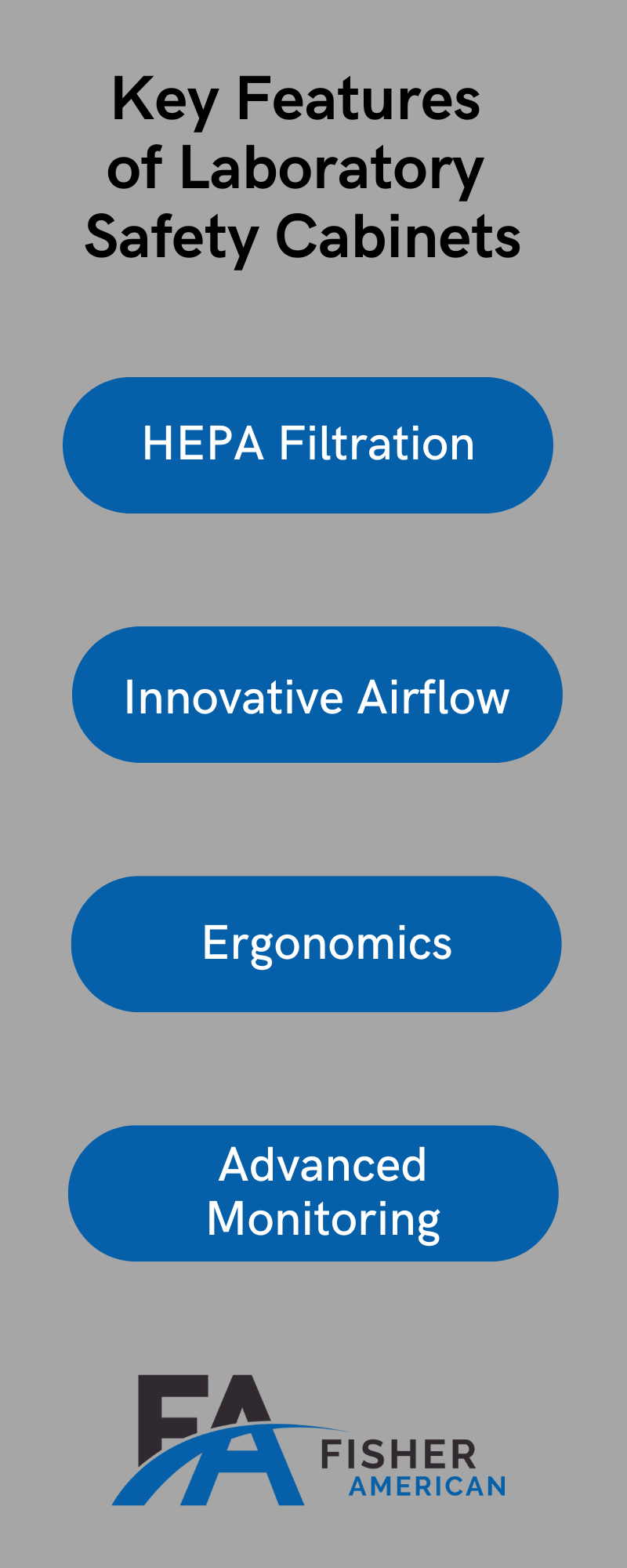
Key Features of Laboratory Safety Cabinets
HEPA Filtration: High-efficiency particulate air (HEPA) filters are crucial in safety cabinets. They effectively capture airborne particles and pathogens, ensuring clean exhaust air.
Innovative Airflow: Cabinets maintain a carefully designed airflow pattern, constantly drawing lab air through filtration, protecting both users and materials.
Ergonomics: Modern safety cabinets prioritize user comfort and convenience, offering adjustable work surfaces, ergonomic chairs, and user-friendly controls.
Advanced Monitoring: Many cabinets include monitoring systems that track factors like airflow, filter status, and UV light, ensuring optimal functionality.
How Do Safety Cabinets Actually Work?
Safety cabinets create a protective air barrier by continuously drawing air inward through the front opening, passing it through one or two HEPA filters, and either recirculating it or exhausting it. This maintains negative pressure at the opening, preventing contaminated air from escaping into the room.
Key mechanical components:
- HEPA filters: Capture ≥99.97% of particles 0.3 microns or larger, including most bacteria and many viruses. Defined by the U.S. EPA.
- Blower/fan system: Maintains consistent airflow velocity across the work opening (typically 75–100 linear feet per minute for Class II A2).
- Sash: The front sliding panel that controls the size of the work opening and must remain at the correct working height for proper airflow.
- UV light (optional): Some models include UV germicidal lamps for surface decontamination between uses. UV light does not substitute for HEPA filtration.
Which Safety Cabinet Do I Need?
The correct cabinet class depends on three factors: the biological risk level of your materials, whether you’re working with volatile chemicals, and your facility’s existing exhaust infrastructure.
Use this decision framework:
| If you are working with… | Start with… |
| BSL-1 agents, non-infectious materials | Class I or Class II A1 |
| BSL-2 agents, cell culture, standard microbiology | Class II A2 |
| BSL-2 agents + low-volatility chemicals | Class II B1 (requires ducting) |
| BSL-2/3 agents + volatile toxic chemicals | Class II B2 (requires ducting) |
| BSL-3 or BSL-4 agents | Class III or augmented Class II; consult a biosafety officer |
For regulated industries (clinical, pharmaceutical, food safety), cabinet selection may be dictated by your accreditation body or applicable standards. Confirm requirements with your regulatory contact before purchasing.
What Certifications and Standards Apply?
In the United States, biosafety cabinets must meet NSF/ANSI Standard 49, which covers design, construction, performance, and field certification.
Key standards to know:
- NSF/ANSI 49: The governing U.S. standard for BSC performance and certification. Look for the NSF mark on any cabinet you purchase.
- CDC/NIH BMBL, 6th Edition: Governs biosafety level requirements and agent handling practices.
- WHO Laboratory Biosafety Manual, 4th Edition: The international reference standard, relevant if your work has global regulatory exposure.
How to Maintain a Safety Cabinet
A safety cabinet that is not properly maintained does not provide the protection it was designed for. Maintenance responsibilities for small business owners include:
- Annual field certification by an NSF-accredited technician. This is required for regulatory compliance in most settings and is the only way to verify ongoing performance.
- Routine surface decontamination before and after each use with an appropriate disinfectant. Consult your biosafety officer or the CDC disinfection guidelines for agent-specific protocols.
- HEPA filter monitoring — most modern cabinets have alerts; older units require manual tracking.
- Sash position compliance — operating the cabinet with the sash above the designated working height disrupts airflow and voids containment assurance.
- Decontamination before service or relocation — cabinets must be decontaminated (typically with formaldehyde gas or vaporized hydrogen peroxide) before filter changes or physical relocation. This is a regulated procedure requiring trained personnel.
Ensuring Well-Being and Integrity
Laboratory safety cabinets are essential for protecting lives, valuable research, and the environment. They quietly serve as safety guardians, enabling scientific progress and contributing to a safer and more sustainable future. It’s important to recognize the significant role these cabinets play in ensuring the well-being of researchers and the integrity of their work. If you have questions or need assistance choosing the right product for your laboratory, please don’t hesitate to contact us.