

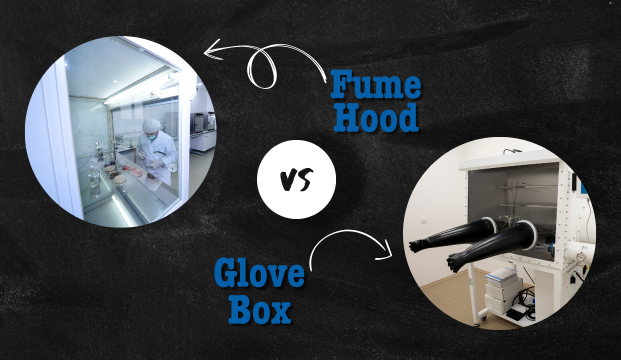
What Is the Core Difference Between a Fume Hood and a Glove Box?
A fume hood protects the researcher from the material. A glove box protects the material from the environment. That single distinction drives nearly every practical difference between the two.
Fume hoods use controlled inward airflow to capture and exhaust contaminants before they reach the researcher. Glove boxes seal the work environment entirely, allowing manipulation through built-in gloves while maintaining a controlled internal atmosphere, typically inert gas or filtered air.
Understanding which protection model your work requires is the starting point for every purchasing or specification decision.
What Is a Laboratory Fume Hood?
A laboratory fume hood is an enclosed workspace created to contain and exhaust hazardous fumes, vapors, or dust generated during various laboratory operations. Its primary purpose is to serve as a protective barrier, preventing researchers from inhaling potentially harmful substances and maintaining a safe working environment.
How it works:
- Inward airflow is maintained at a face velocity typically between 80 and 120 feet per minute, per ANSI/AIHA Z9.5 laboratory ventilation standards.
- Ducted fume hoods exhaust contaminated air to the outside or through treatment systems.
- Ductless fume hoods filter air through activated carbon or HEPA filters and recirculate it within the building. These are suitable only for specific chemical classes and require careful filter selection and maintenance.
Common applications:
- Chemical synthesis and handling
- Work with volatile solvents
- Sample preparation involving hazardous reagents
- Acid digestion
What fume hoods do not do: They do not protect materials from air or moisture exposure. They do not provide a contamination-free environment for the sample. If the material is the sensitive element, a fume hood is insufficient.
Related:
What Is a Laboratory Glove Box?
A laboratory glove box (also called an isolation glove box or containment chamber) is a sealed enclosure that allows researchers to manipulate materials through integrated arm-length gloves mounted in the chamber wall, without breaking the internal atmosphere.
Primary function: Maintain a controlled internal environment, protecting sensitive materials from external air, moisture, oxygen, or biological contamination.
How it works:
- An airlock (antechamber) with two interlocked doors allows transfer of materials in or out without exposing the main chamber to ambient conditions.
- The internal atmosphere is customizable: inert gas (commonly nitrogen or argon), filtered air, or specific humidity and temperature conditions.
- Built-in monitoring systems track oxygen levels, humidity, and pressure differential.
Common applications:
- Handling air-sensitive or moisture-sensitive compounds (e.g., organolithium reagents, certain catalysts)
- Biological research requiring contamination-free sample environments
- Semiconductor and battery material fabrication
- Pharmaceutical work with highly hazardous compounds requiring full containment
What glove boxes do not do: They are not designed primarily for researcher protection from acute inhalation hazards the way fume hoods are, though negative-pressure glove boxes can provide containment for hazardous substances.
Fume Hood vs. Glove Box: Side-by-Side Comparison
| Feature | Fume Hood | Glove Box |
|---|---|---|
| Primary protection | Researcher from material | Material from environment |
| Enclosure type | Open-front, ventilated | Fully sealed |
| Atmosphere control | No | Yes (inert gas, humidity, temp) |
| Material manipulation | Direct hand access | Through integrated gloves |
| Airlock for transfer | No | Yes (antechamber) |
| Typical use | Chemical handling, volatile solvents | Air-sensitive compounds, biological samples |
| Exhaust required | Yes (ducted) or filtered recirculation (ductless) | Not typically (unless negative-pressure hazardous model) |
| Relative cost | Lower | Higher (capital and operational) |
| Space footprint | Moderate | Larger, plus gas supply infrastructure |
Maintenance and Compliance Requirements
Both types of equipment require regular inspection and certification, not just installation.
Fume hoods:
- Annual face velocity testing is required under most state and institutional guidelines.
- Sash operation, airflow alarms, and exhaust connections should be inspected at least annually.
- The American Industrial Hygiene Association standard ANSI/AIHA Z9.5 is the primary U.S. reference.
Glove boxes:
- Oxygen and moisture sensor calibration should be performed per manufacturer specifications, typically quarterly.
- Gloves and seals degrade over time and must be inspected regularly. Glove failure during work with hazardous materials poses a direct exposure risk.
- Antechamber integrity and interlock function should be tested before each use session involving hazardous materials.
Keeping maintenance logs is important not only for safety but for demonstrating compliance during facility inspections or audits.
If you need assistance in choosing the right equipment for your work area, please don’t hesitate to contact us. At Fisher American, we have a remarkable selection of laboratory fume hoods and laboratory cabinets. Products ship in most cases within two weeks. For help determining which equipment is appropriate for your application, contact the Fisher American team or browse the fume hood product line.
Frequently Asked Questions
No. A fume hood does not control the internal atmosphere or prevent air and moisture from reaching materials. For air-sensitive or moisture-sensitive compounds, a fume hood does not protect the material itself.
In limited scenarios, a negative-pressure glove box can provide researcher protection from hazardous materials, but this is not the standard design intent. For routine chemical work generating fumes or vapors, a fume hood is the correct and more practical tool.
Certification testing verifies that the fume hood maintains adequate face velocity across the sash opening, that the airflow alarm functions correctly, and that no significant turbulence or reverse flow is occurring. ASHRAE 110 is the recognized test method for fume hood performance.
Ductless fume hoods are appropriate only for specific chemical classes and require matching the correct filter media to the chemicals in use. They are not suitable for all applications.