

Face velocity testing is one of the most common and most misunderstood ways to evaluate fume hood performance. While it’s not the only indicator of safety, it plays a central role in ensuring airborne contaminants are captured and exhausted properly.
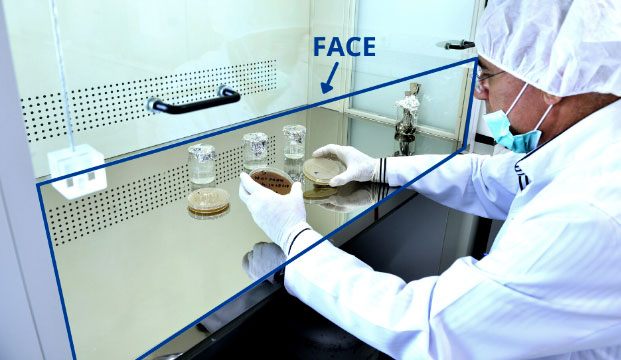
What is a Fume Hood Face?
The face of a fume hood is the vertical plane between the bottom of the sash and the work surface. It’s the opening where room air is drawn into the hood.
This area matters because:
- It’s where air enters the hood
- It’s the boundary between the lab and the containment zone
- It directly affects operator exposure
What is Face Velocity?
Face velocity is the speed at which air moves through the fume hood opening. It’s measured in feet per minute (FPM).
In simple terms, face velocity tells you how aggressively the hood pulls air away from the user and into the exhaust system.
Why It Matters
- Too high: Airflow becomes turbulent, energy use increases, and containment can suffer
- Too low: Vapors and fumes may escape back into the lab
Most labs aim for a balance that protects users without wasting energy.
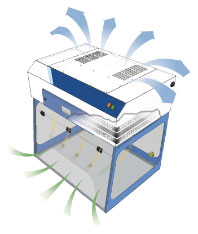
Recommended Face Velocity Ranges
Face velocity is not one-size-fits-all. Acceptable ranges depend on fume hood type, application, and local safety requirements.
General Guidelines
- Traditional constant-volume hoods:
Typically 60–100 FPM - Higher-risk applications:
May require up to 120 FPM - VAV (Variable Air Volume) hoods:
- ~100 FPM with sash open
- As low as 60 FPM when the sash is closed
Always confirm requirements with your safety officer or local code authority.
How Face Velocity Is Tested
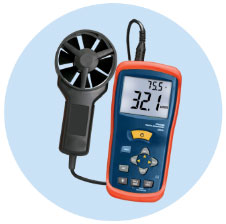
Face velocity testing measures airflow speed across the hood opening using a digital anemometer.
Standard Testing Method
- Divide the hood opening into an imaginary grid
(Each section is typically ~1 square foot) - Measure airflow at the center of each grid section
- Record all readings
- Calculate the average face velocity
- Review results for outliers or inconsistencies
Typical Passing Criteria
- Average face velocity generally falls between 95–130 FPM
- Individual readings should not vary more than ±20% from the average
Large variations often indicate turbulence, obstructions, or airflow imbalance.
What Face Velocity Testing Can, and Can’t, Tell You
Face velocity is an important performance metric, but it’s only one piece of the puzzle.
What It Tells You
- Whether airflow volume is within an acceptable range
- If the hood is receiving adequate exhaust
- If basic airflow performance meets standard requirements
What It Doesn’t Tell You
- How well the hood contains fumes
- Whether contaminants escape under real working conditions
- How operator movement affects containment
Because of this, face velocity alone should not be treated as a guarantee of safety.
ASHRAE 110 Testing: A More Complete Picture
The ASHRAE 110 Method is the industry benchmark for evaluating fume hood performance. It goes beyond airflow speed and evaluates actual containment.
The ASHRAE 110 Test Includes:
- Face velocity measurements
- Smoke visualization
- Tracer gas containment testing
Testing Conditions
- As Manufactured (AM):
Conducted in a controlled lab before shipment - As Installed (AI):
Performed after installation in the lab - As Used (AU):
Conducted during normal lab operation with equipment and personnel present
These tests reveal how a hood performs in real-world conditions, not just on paper.
Environmental Factors That Affect Face Velocity
Even a properly designed hood can underperform due to external airflow disruptions.
Common Issues
- Supply diffusers blowing air toward the hood opening
- People walking directly in front of the hood
- Open doors or windows, causing pressure changes
- Ventilation system imbalance
- Large equipment blocking the airflow
These factors can pull contaminants out of the hood, even when face velocity appears acceptable.
Interpreting Face Velocity Results
If face velocity falls outside the recommended range, the hood’s performance may be compromised.
Potential Causes of Low or High Readings
- Sudden air influx from doors or windows
- Improper diffuser placement
- Exhaust system imbalance
- Room pressure issues
- Obstructed airflow inside the hood
The speed of air entering the hood directly affects containment. Either extreme—too fast or too slow—can reduce effectiveness.
How Often Should Face Velocity Be Tested?
Most safety programs require face velocity testing every three months, in accordance with OSHA guidance and institutional safety policies.
Additional testing is recommended:
- After installation
- After HVAC changes
- If hood performance appears inconsistent
- When processes or equipment change
When to Go Beyond Face Velocity Testing
If your lab handles hazardous chemicals, highly toxic substances, or volatile compounds, face velocity alone may not be sufficient.
In those cases:
- Smoke visualization
- Tracer gas testing
- Professional certification testing
provide a clearer picture of actual containment performance.
Why Face Velocity Testing Matters for Lab Safety and Compliance
Face velocity testing is a foundational step in maintaining lab safety, but it works best as part of a broader performance evaluation.
Understanding what the numbers mean, what affects them, and when additional testing is required helps ensure your fume hoods protect both people and processes.