



TL;DR
- A passing number is an average air speed from one test day, at one sash position, in whatever conditions the room was in that day.
- ANSI/ASSP Z9.5-2022 says face velocity can’t be the only performance indicator. SEFA and Prudent Practices take the same position.
- A low reading is a useful warning. An acceptable reading tells you much less, especially in the range where most labs operate.
- Foot traffic, supply diffusers, doors, and sash movement can all pull vapors out of a hood, and most of them come and go between tests.
- Annual testing is a minimum. Retesting is also due after changes to the hood or ventilation system.
- The annual number works best as a drift check against a containment-tested baseline. Without that baseline, it has little to compare against.
- We haven’t counted how many in-service hoods with passing stickers leak during daily work, and we didn’t find a representative count anywhere else.
A passing face velocity number tells you the average speed of air entering the hood on one test day, at one sash position, in whatever conditions the room happened to be in. It doesn’t tell you the hood contains vapors while someone works at it. Use it as a drift check, and stop reading it as a safety verdict.
We already cover the procedure in How To Test A Fume Hood’s Face Velocity and the broader question in How Effective Is a Fume Hood? This post is about what happens after the test, when everybody sees the sticker and relaxes.
What does a passing face velocity number actually prove?
It proves the average inward air speed landed inside your acceptance range during the test. That’s worth knowing, because a low reading is a real warning. It doesn’t prove containment, since containment depends on turbulence, room air currents, the operator, and what’s in the hood, and an average can’t show those.
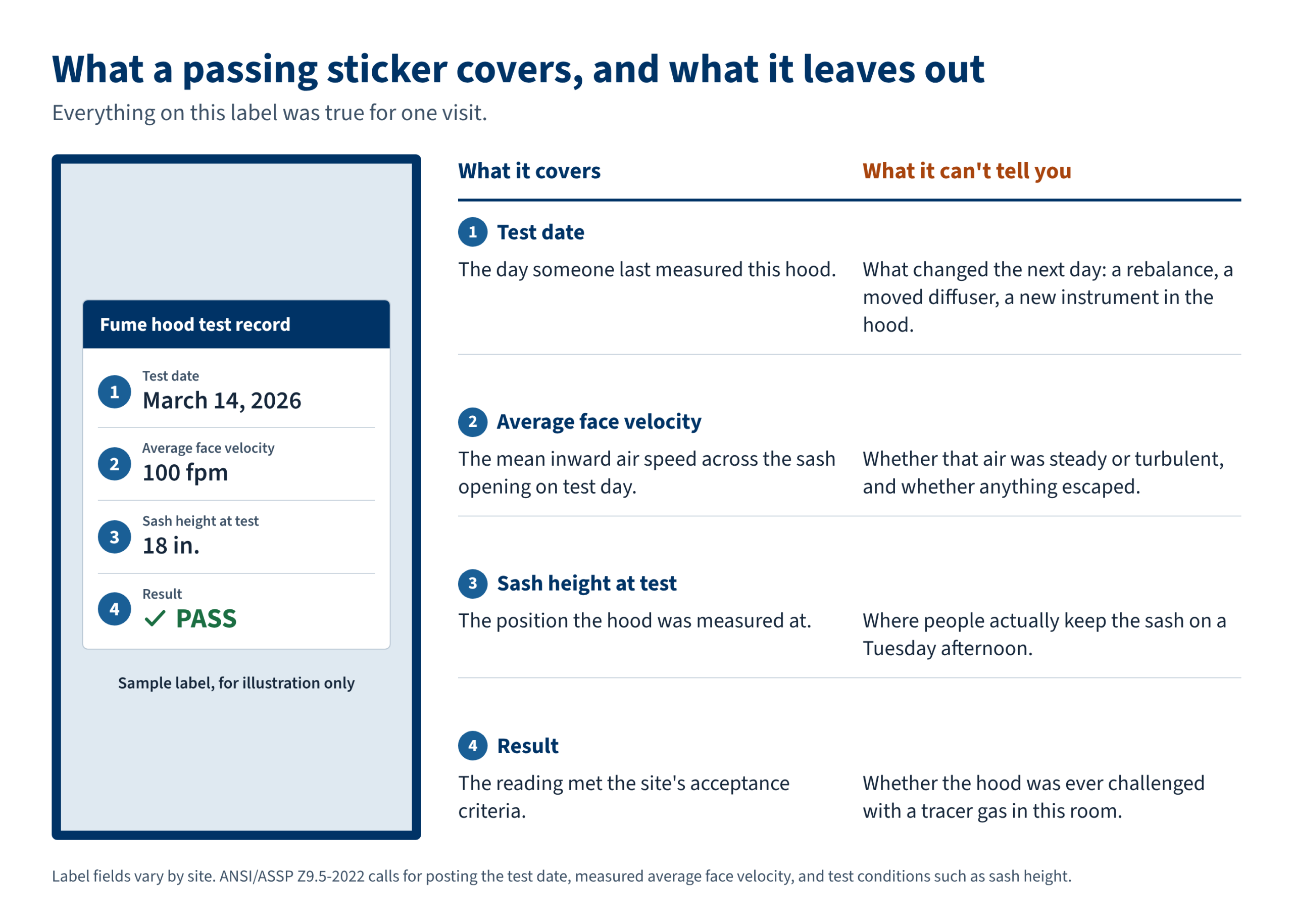
Z9.5’s posting language calls for the test date, the measured average face velocity, and conditions like sash height. Here’s what those entries leave open:
| What gets posted | What it can’t tell you |
|---|---|
| Test date | What changed the day after: a rebalance, a moved diffuser, a new instrument in the hood |
| Average face velocity | Whether the air was steady or turbulent, and whether anything escaped |
| Sash height at test | Where people actually keep the sash on a Tuesday afternoon |
| Pass | Whether the hood was ever challenged with a tracer gas in this room |
Z9.5 does list cross-draft measurement in the routine test. Those readings live in the report, though, and the report isn’t taped to the hood. Check whether your program takes them at all. Tom Smith of testing firm 3Flow, who sits on the ASHRAE 110 and Z9.5 committees, writes that most organizations use average face velocity measurements.
Why does a passing sticker make everyone relax?
It turns a complicated question into one green check on the sash. Users read it as permission, managers read it as compliance, and auditors can photograph it. Nobody has to think about the room again until next year, which is the actual hazard, because the conditions that cause leaks keep changing between visits.
Most safety officers already know this. The trouble is that the sticker keeps doing its job anyway.
A chemist glancing at a current date doesn’t think "average velocity at 18 inches last March." They think "this hood is good." Thomas Wilson, a professional engineer at Wilson Engineered Systems, argued years ago that marking a sash at a velocity limit misleads employees into believing safety testing has happened. His paper also makes the case for engineered high-performance hoods, so weigh it with that in mind. The point about the sash mark holds up on its own.
The sticker also ends conversations. If a user says a hood smells off in the afternoon, a current date on the label makes that complaint easier to dismiss. Prudent Practices says the opposite should happen: any reported problem calls for a performance test.
What do OSHA, ANSI Z9.5, and SEFA say about face velocity as a safety measure?
None of the main references treat face velocity as a safety verdict. ANSI/ASSP Z9.5-2022 says it can’t be the only performance indicator, SEFA says it doesn’t measure safety, Prudent Practices calls it one indicator, and federal OSHA sets no number. Some state and local rules do set one, so check your jurisdiction.
| Source | Its position |
|---|---|
| ANSI/ASSP Z9.5-2022, section 4.3.1 | Face velocity "shall not be used as the only performance indicator." The notes also call it inappropriate to prescribe one acceptable range for all hood styles. |
| SEFA 1.2-2002, section 4.3.1 (same excerpt document) | Face velocity has to be adequate for containment, but SEFA states flatly that it doesn’t measure safety. |
| Prudent Practices in the Laboratory, 9.C.2.1 | "Face velocity is only one indicator of hood performance," and shouldn’t be the sole basis for judging containment. |
| OSHA 29 CFR 1910.1450(e)(3)(iii) | The Chemical Hygiene Plan must require that hoods function properly, with specific measures to ensure it. Prudent Practices notes the standard doesn’t specify a test protocol. |
OSHA left this to employers on purpose. Its 1990 preamble, as quoted by Wilson, says employers set face velocity based on design, use patterns, and other factors affecting the hood.
Local rules can be stricter. Weill Cornell, for example, cites a New York City Fire Department requirement for its hoods. A local minimum is a legal floor, and clearing it still doesn’t show containment.
How well does face velocity predict fume hood containment?
Poorly, in the range most labs operate. In a field study of 54 installed hoods, velocities around 60 to 96 fpm gave a rough mix of good and poor containment. Very low readings predicted trouble far better than acceptable readings predicted safety. A low number is a warning. An acceptable one settles little.
That study, Rydock (2000), tested hoods in three Norwegian lab buildings using two abridged tracer methods. The author used 1 ppm of nitrous oxide as an example control value, so read this as a pattern and don’t borrow the threshold:
| Face velocity at test | Hoods | Over 1 ppm, method 1 | Over 1 ppm, method 2 |
|---|---|---|---|
| Under 0.3 m/s (about 60 fpm) | 12 | 11 | 11 |
| 0.3 to 0.49 m/s (about 60 to 96 fpm) | 27 | 12 | 17 |
| 0.5 m/s and up (about 98 fpm and up) | 15 | 3 | 1 |
Look at the middle row. It holds half the hoods and overlaps the 80 to 100 fpm design range most people recognize. Inside that band, Rydock concluded, face velocity couldn’t serve as an indicator of containment.
Other evidence points the same way, with varying strength:
- Prudent Practices reports that 28% or 38% of hoods in two evaluations missed the pass criteria even though face velocity alone put them in an acceptable range. It doesn’t give sample details in that passage, and the figures are old.
- 3Flow’s Smith reports that 15% to 30% of hoods in his firm’s thousands of tests missed Z9.5 criteria. That’s a testing firm’s client data, so it’s a real number from a non-random sample.
- Stan Lengerich, CIH, a Z9.5 committee member at the time, wrote on the ACS safety listserv that his company’s thousands of tracer tests, run from 60 to 150 fpm, showed an extremely low correlation with face velocity. He also described identical enclosures side by side where one passed and one failed. That’s a practitioner’s report, and it isn’t peer-reviewed.
Face velocity still has real value. A University of North Carolina thesis found face velocity, its variability, and cross drafts all mattered to leakage, and called average face velocity a useful monitoring technique. Prudent Practices also warns that readings both too low and too high hurt containment. The number earns its place as a monitor. The mistake is promoting it to a verdict.
How do cross-drafts defeat a hood that passed its face velocity test?
A walking person can stir up air about two and a half times faster than the 100 fpm face velocity in Prudent Practices’ example, and much weaker currents already hurt containment. Diffusers, doors, and foot traffic all do this, mostly at moments an annual test never samples.
How fast is the air competing with the hood?
These figures all come from Prudent Practices, 9.C.2.2:
| Air movement | Speed |
|---|---|
| Air most people first notice as movement | About 20 fpm |
| Face velocity in the book’s worked example | 100 fpm |
| A person walking, plus the vortices behind them | About 250 fpm, with vortices above that |
| Air at the face of a ceiling supply diffuser | Frequently over 800 fpm |
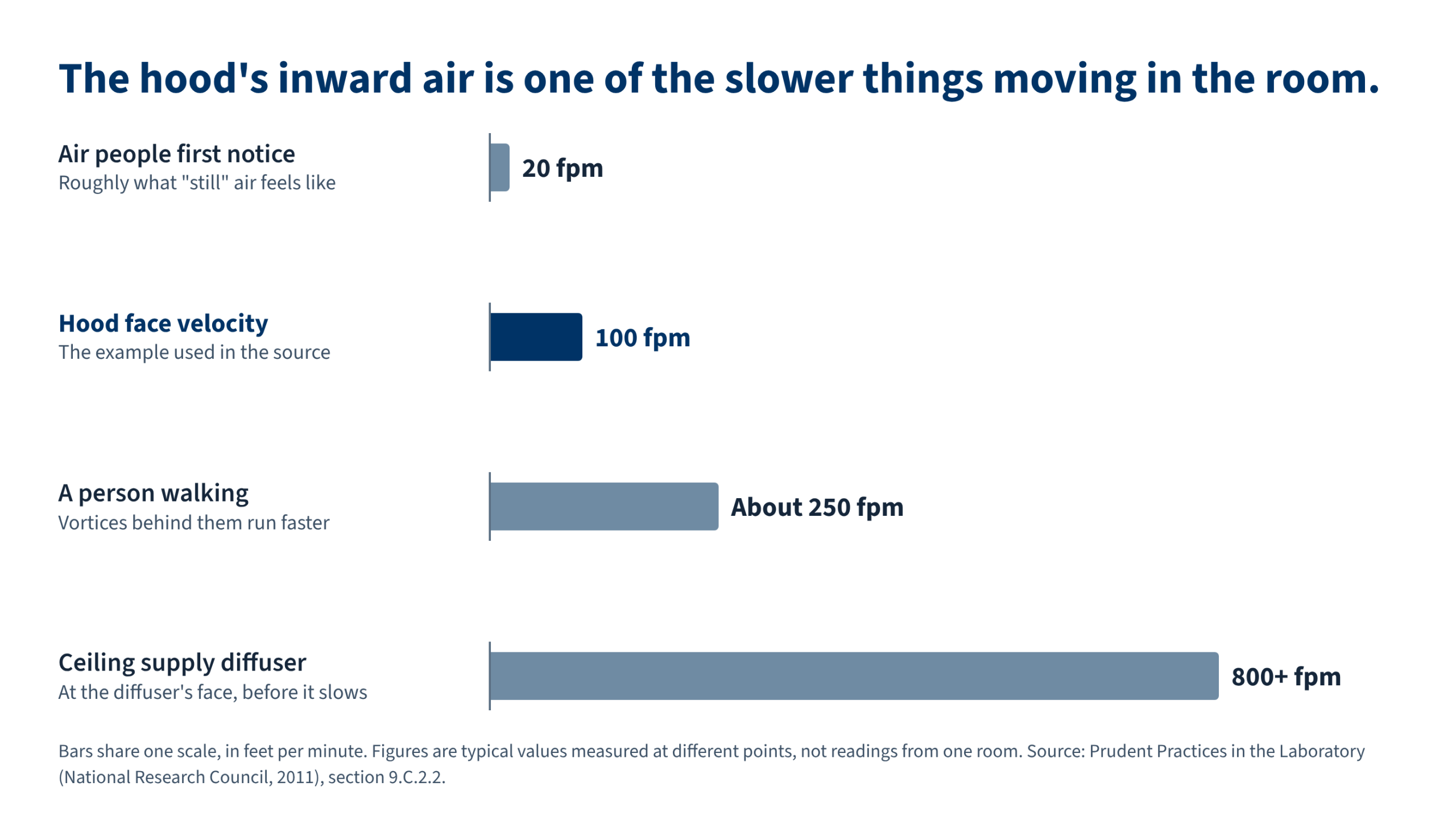
An inward flow you can barely feel on your wrist is competing with all of that.
What did the research measure?
- Walk-bys: Tseng et al. (2007) ran a moving plate past a full-scale fume cupboard at about 100 fpm face velocity to simulate a person passing. Peak tracer in the manikin’s breathing zone hit nearly 20 to 50 times the static level, with each pass producing its own spike. That’s one transparent test cupboard in a controlled room, so treat the multiplier as a demonstration.
- Room air: A NIOSH-authored study of a nano fume hood at 60, 80, and 100 fpm found leakage mainly when the room air conditioner was running, at the low and medium airflows, and worst on the side nearest the supply diffuser. With the air conditioner off, the static tracer tests showed good containment across most conditions. Same hood, same settings, different room air.
- Direction matters: The UNC thesis found cross drafts more likely to cause leakage when they flowed in a direction that separated air along the hood’s beveled edge. A single speed reading misses that.
Why doesn’t test day catch this?
Z9.5 asks for cross-draft readings over 10 to 30 seconds at set points in front of the opening. That’s a useful snapshot of steady room air, and a poor way to catch the postdoc who cuts behind the operator at 2 p.m.
Prudent Practices makes the distinction well: traffic effects are transient, and diffuser effects are constant but usually milder. A short visit can pick up the second one. It’s unlikely to catch the first, and neither shows up in an average face velocity.
What’s an acceptable cross-draft?
The references don’t agree, and we’re not going to pick a winner for you:
- Prudent Practices says containment falls when currents exceed 30% to 50% of face velocity.
- Smith describes Z9.5 as recommending under 50%, and adds that some hoods are more sensitive than others.
- NFPA 45’s annex, in the 2000 edition excerpted by TSI, says ideally under 30%.
Your hood’s real limit comes from containment testing in your room.
How does real sash use change what the number means?
The posted number describes one sash position, usually the tested working height. On a constant volume hood, face velocity changes as the sash moves, and on any hood a fast sash movement can throw contaminated air out. Once people raise the sash past that mark, the number describes a hood they’re no longer using.
The number belongs to one sash position
Prudent Practices explains that on a constant air volume hood, face velocity varies inversely with sash position. The recommended velocity often exists over only a limited range of positions.
Prudent Practices also tells you to test where people really work: if users sometimes run with the vertical sash fully open, the acceptance criteria should cover 100% open. It’s common to test at a standard position, often 18 inches, and call that the answer.
The Rydock study shows why this matters. One hood read 0.25 ppm with a 30 cm sash and 15 ppm with a 67 cm sash. The sampling point changed along with the height, so the sash doesn’t get all the blame, but the same hood gave two very different answers.
Moving the sash is its own challenge
Tseng et al. watched a rapid sash opening form a jet-like flow that carried smoke out and into the manikin’s breathing zone, with the event playing out over about 20 seconds. Tracer around the breathing zone peaked at the moment the sash opened.
VAV hoods add another variable, because the controls have to catch up with the sash. Z9.5 calls for flow to recover within 5 seconds or as specified in the design documents, and Smith is blunt that a face velocity reading alone won’t confirm those controls work. They can also degrade over time.
People move the sash for ordinary reasons
Nobody raises a sash to be reckless. They’re reaching for apparatus near the top of the hood, or they’re tall, or the setup won’t clear at working height. Prudent Practices acknowledges all of this, and warns that using a sash stop to hold a fully raised position can turn into a habit.
An Oregon State University survey of 75 VAV hoods in one building found many left open with nobody at them. That’s a campus snapshot, and it isn’t a rate you can apply to an industrial lab. How often do hoods in industrial labs run above their tested height? We haven’t counted it yet.
You can count your own, if your hoods report sash position. An MIT study tracked sash height using building management system data, and that same trend could tell you how your hoods are being run.
What’s in the hood changes the answer too
Prudent Practices reports that breathing-zone concentration can be 300 times higher from a source at the front of the face than from one at least 6 inches back. It also warns that large equipment creates dead spaces in the airflow. A test on an empty hood can’t speak to any of that, and it’s why ASHRAE 110 recognizes an "as used" test condition.
Is testing a fume hood once a year enough?
No. Annual testing is the minimum in ANSI/ASSP Z9.5-2022 and Prudent Practices, and it only confirms the hood still matches its last proven condition. Retesting is also due after significant changes, and users should check the monitor every time. A hood can pass in March and leak after an April rebalance.
What the references call for between annual tests
| When | What’s called for | Source |
|---|---|---|
| Every use | Check the continuous performance monitor | Prudent Practices 9.C.2.4 |
| At least annually, or as necessary | Routine performance tests | Z9.5 7.3.5; Prudent Practices 9.C.2.8.2 |
| A problem gets reported | Performance test | Prudent Practices 9.C.2.8 |
| Significant change to the hood system | Routine tests, under management of change | Z9.5 7.3.5 |
| Rebalancing or recommissioning | Containment test | Prudent Practices 9.C.2.8 |
| Supply volume, diffuser location, or added local exhaust changes | Reevaluate all hoods in the lab | Prudent Practices 9.C.2.8.3 |
| Concern about protection in actual use | Personal air sampling during real work | Prudent Practices 9.C.2.8.7 |
Sources: Prudent Practices, chapter 9; Z9.5 excerpts in TSI’s application note.
One thing to watch: older guidance still circulates saying OSHA’s Appendix A wants ventilation checked every 3 months and face velocity at 60 to 100 lfm. The current Appendix A, revised in a 2013 technical amendment, doesn’t contain either line. It says hoods should be maintained, monitored, and routinely tested. It’s also non-mandatory, so check what your own plan says and where it got that language.
What the annual number is good for
The annual reading makes sense as a comparison. Prudent Practices says to note the face velocity once a hood passes ASHRAE 110 or an equivalent, then use it as the reference point for routine testing. Z9.5 follows the same logic: variations over 10% from the latest commissioning results get investigated, and a hood more than 10% below its designated average gets labeled out of service or restricted.
So the routine test asks a narrow question: has this hood drifted from the condition in which it was proven? Smith notes you may not need periodic tracer tests when operation matches the commissioning conditions.
That whole structure rests on a baseline. Smith also estimates fewer than 10% of the roughly 1.4 million US fume hoods have had quantitative tracer gas tests. It’s one expert’s 2020 estimate, and if it’s close, most annual readings are being compared to a design target and never to a proven condition in that room.
What should you do with a passing face velocity number?
Use it as one input. Confirm the hood has a containment baseline, compare today’s reading to it, then look at what the test can’t see: traffic, diffusers, doors, sash habits, and clutter during real work. Where the hazard is high or conditions have changed, go to tracer testing or personal air sampling.
- Find the baseline. Pull the commissioning record. Was this hood tracer tested in this room, at what velocity, and at what sash position? If nobody can find it, that’s your first finding.
- Read the report instead of the sticker. Look at cross-draft readings, smoke results, and the spread across the face. A fine average can sit on top of an uneven profile.
- Stand at the hood during the busiest hour. Note who walks behind it, what’s blowing from the ceiling, and which door opens. Compare what you see to the room conditions on test day.
- Pull the sash data. If your building management system logs sash position, compare the trend to the tested height. If it doesn’t, walk the lab a few times at different hours and write down what you find.
- Watch one real procedure. See how far back the source sits, what’s blocking the baffles, and how fast the sash moves.
- Match the test to the hazard. Smith says the need for as-used tests is often left to the chemical hygiene officer, based on risk. Prudent Practices suggests considering a release rate up to 8 L/min where heated volatile work is possible, and personal air sampling whenever protection is in doubt.
- Change what the label says. Add the containment test date next to the velocity date, or post "velocity check only" where that’s the truth. Users should be able to tell which kind of test happened.
- Put the rules in your plan. Prudent Practices says each lab or site must define its acceptance criteria and when ASHRAE 110 or visualization testing is required, and that those requirements belong in the Chemical Hygiene Plan and ventilation management plan.
What don’t we know about passing hoods that leak?
Nobody we can find has a representative count of how many in-service hoods with passing stickers leak during daily work. We haven’t counted it either. The published figures are old, small, or from testing firms, and even tracer tests with a mannequin don’t fully match a live operator.
- No population rate. Rydock’s 54 hoods were in three Norwegian buildings. The 15% to 30% figure comes from one firm’s clients. The 28% and 38% figures are old. None of them tells you the odds for your lab.
- No "correct" number from us. Z9.5 itself says one range doesn’t fit all hood styles, and we aren’t going to offer a better one.
- Passing a tracer test has limits too. Altemose et al. found manikin and human-subject tracer results inconsistent. Lengerich, an advocate of tracer testing, says it isn’t the final word. SEFA cautions against implying that its AM 0.05 level is safe, since safe exposure levels depend on the application.
- Tracer testing isn’t cheap or simple. Smith cites the cost and complexity of the equipment, and SF6’s greenhouse impact is prompting work on alternative tracers. Rydock pointed to cost as the reason routine tracer testing hasn’t caught on. Your plan has to account for that.
What if your review shows you need a new hood or lab cabinets?
Fix the room first if the room is the problem, because a new hood won’t solve a badly placed diffuser or a busy aisle. If your review shows a hood is at the end of its life or doesn’t suit the work, or that chemicals have no proper home, Fisher American can help you sort out what fits.
A new hood also starts the cycle over. It still needs a containment test in its final location before anyone relies on it, and that test gives you the baseline every later reading gets compared to.
Storage is often part of the same conversation. OSHA’s Appendix A says chemicals shouldn’t be stored in the hood, and bottles parked there can get in the way of airflow. If your walk-through keeps turning up full hoods, the fix may be a cabinet.
If you’re weighing a replacement, browse our fume hoods and laboratory cabinets, or get in touch with our team. It helps to have your chemicals and procedures, your room layout, and the sash height people actually work at.